Items
1. Read Aloud
prep 35s · record 40s · ~1:15Read the text on screen aloud, as naturally and clearly as you can. Recording starts when the timer ends.
Prompt ra-002 · target · science / health
Skills: speaking · Traits: content, pronunciation, oral fluency
Sleep plays a central role in how the brain stores new information. During deep sleep, connections formed while learning are strengthened, and less useful ones are weakened. This is one reason students who revise late into the night often remember less than those who study earlier and rest properly. Even a short afternoon nap can improve recall.
Content key
- The passage, word for word.
2. Repeat Sentence
audio ~5s · prep 3s · record 15s · ~0:23You will hear a sentence once. Repeat it exactly as you heard it.
Prompt rs-001 · foundation · university life · plays as audio
Skills: listening + speaking · Traits: content, pronunciation, oral fluency
The library extends its opening hours during the final two weeks of semester.
Content key
- The sentence, word for word, in order.
3. Repeat Sentence
audio ~6s · prep 3s · record 15s · ~0:24You will hear a sentence once. Repeat it exactly as you heard it.
Prompt rs-004 · stretch · technology / education · plays as audio
Skills: listening + speaking · Traits: content, pronunciation, oral fluency
Compared with printed textbooks, digital resources are cheaper to update but harder to read for long periods.
Content key
- The sentence, word for word, in order.
4. Describe Image
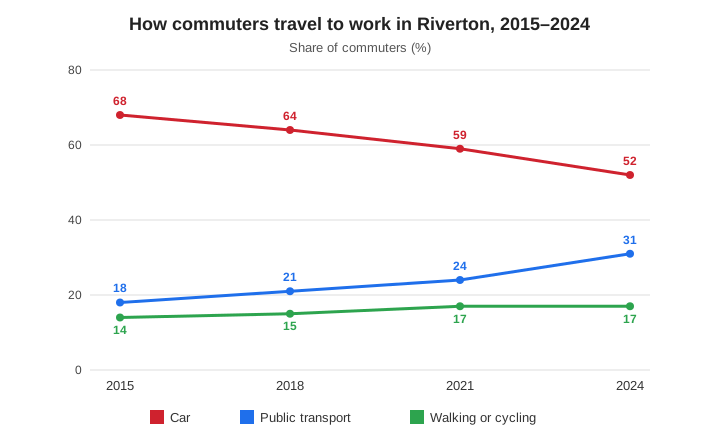
prep 25s · record 40s · ~1:05Look at the image. When recording starts, describe it in detail: the main trend, key numbers, and how the parts relate.
Prompt di-002 · target · transport / society
Skills: speaking · Traits: content, pronunciation, oral fluency
Content key
- Main feature: the car remained the most common way to commute, but its share fell steadily from 68% in 2015 to 52% in 2024.
- Detail: public transport rose from 18% to 31%, with the biggest jump between 2021 and 2024 (24% to 31%).
- Detail: walking or cycling grew slightly, from 14% to 17%, and was flat between 2021 and 2024.
- Relationship: the gap between car and public transport narrowed from 50 points to 21 points.
- Relationship: most of the share lost by cars went to public transport rather than walking or cycling.
5. Re-tell Lecture
audio ~75s · prep 10s · record 40s · ~2:05You will hear a short lecture once. Then re-tell it in your own words, covering the main points.
Prompt rl-001 · target · environment / urban planning · plays as audio
Skills: listening + speaking · Traits: content, pronunciation, oral fluency
Today I want to look at why some cities flood more than others after heavy rain. First, it's tempting to blame the rainfall itself, but the bigger factor is usually what covers the ground. In a forest, most rain soaks into the soil. In a modern city, roads, car parks and roofs don't absorb water, so it runs straight into the drains. As a result, when heavy rain arrives, those drains fill up and the water comes back onto the streets. Second, older cities have an extra problem. Their drainage systems were built for the rainfall of a hundred years ago, and storms today tend to be more intense. Finally, some cities are now trying a different approach, often called sponge design. Instead of bigger pipes, they build permeable pavements, rain gardens and small wetlands that hold water and release it slowly. This is usually cheaper than replacing pipes, and it has side benefits: it cools the city and gives wildlife somewhere to live.
Content key
- Ground cover matters more than rainfall: soil absorbs rain, but city surfaces like roads and roofs don't.
- Water therefore runs into drains, which overflow onto streets in heavy rain.
- Older cities' drainage was designed for past rainfall, while today's storms are more intense.
- Response: 'sponge design' (permeable pavements, rain gardens, wetlands) stores water and releases it slowly.
- Detail: sponge design is cheaper than new pipes and also cools the city and supports wildlife.
6. Answer Short Question
audio ~4s · prep 3s · record 10s · ~0:17You will hear a question. Answer it with a single word or a few words.
Prompt asq-004 · foundation · geography · plays as audio
Skills: listening · Traits: contentListening only, not counted in speaking score
What do we call a large, dry area of land that gets very little rain?
Accepts: desert / a desert / the desert
Content key
- desert
7. Answer Short Question
audio ~4s · prep 3s · record 10s · ~0:17You will hear a question. Answer it with a single word or a few words.
Prompt asq-003 · foundation · daily life · plays as audio
Skills: listening · Traits: contentListening only, not counted in speaking score
Where can members of the public borrow books for free?
Accepts: library / a library / the library / public library / a public library
Content key
- library (also accepted: public library)
8. Respond to a Situation
audio ~18s · prep 10s · record 40s · ~1:08Read and listen to the situation. Then respond as you would in real life, speaking directly to the person involved.
Prompt rts-002 · target · work / study balance · plays as audio
Skills: speaking · Traits: content, pronunciation, oral fluency
You work part-time at a café. Your manager has asked you to cover an extra shift this Saturday because two staff members are away. You have an important exam on Monday and had planned to spend the weekend studying. Speak to your manager and decline the extra shift.
Content key
Goal: Decline the extra Saturday shift while keeping a good working relationship.
Register: Respectful workplace register: polite and clear to a manager, neither blunt nor over-apologetic.
- Clearly says they can't take the Saturday shift.
- Gives the reason: an important exam on Monday and the weekend set aside to study.
- Acknowledges the manager's situation (staff away) and ideally offers an alternative, such as a shift after the exam.
9. Summarize Group Discussion
audio ~165s · prep 10s · record 120s · ~4:55You will hear three people discussing a topic, once. Then summarize the discussion: each speaker's main view and how their views relate.
Prompt sgd-002 · target · university life / careers · plays as audio
Skills: listening + speaking · Traits: content, pronunciation, oral fluency
Three students discuss whether universities should require an internship before graduation.
Arjun: I think every degree should include a required internship. Employers keep saying graduates don't have real work experience, and an internship is the most direct way to get it before you finish.
Sophie: I'm against making it compulsory. Many internships are unpaid, and students who need to work paid jobs to cover rent simply can't afford to take a few months off for free work.
Tom: I see both sides. I'd support a requirement, but only if the internships are paid, or if students can choose an alternative, like an industry project run through the university.
Arjun: Tom's alternative makes sense. My main concern is that students graduate with something practical on their CV. A good industry project could do that.
Sophie: Even so, Arjun, the quality varies hugely. Some interns just make coffee for three months. A requirement doesn't guarantee they learn anything useful.
Tom: That's a fair point, Sophie. So the university would need to approve placements and check that students are given real tasks, not just errands.
Sophie: If it were paid and properly checked, I could accept it. My objection is really to unpaid work being forced on people.
Arjun: Then I think we mostly agree with Tom: make it required, but paid or with a project option, and monitored by the university.
Content key
- Arjun: supports a compulsory internship; employers say graduates lack work experience.
- Arjun: his priority is practical experience on the CV, so he accepts an industry project as an alternative.
- Sophie: opposes making it compulsory; unpaid internships exclude students who must work paid jobs.
- Sophie: internship quality varies; some interns do only menial tasks, so a requirement doesn't guarantee learning.
- Tom: conditional support; requirement only if internships are paid or there is an alternative such as a university industry project.
- Tom: the university should approve placements and check that interns do real work.
- Outcome: all three converge on a requirement that is paid or offers a project option and is monitored by the university.
Cross-references
- Arjun accepts Tom's alternative.
- Sophie challenges Arjun on internship quality.
- Tom answers Sophie's quality concern with university approval and checks.
- Arjun sums up agreement with Tom's model; Sophie accepts it on condition it is paid and checked.