Items
1. Read Aloud
prep 35s · record 40s · ~1:15Read the text on screen aloud, as naturally and clearly as you can. Recording starts when the timer ends.
Prompt ra-001 · target · environment / cities
Skills: speaking · Traits: content, pronunciation, oral fluency
Urban heat islands form when concrete, asphalt and dense buildings absorb sunlight during the day and release it slowly at night. As a result, city centres can be several degrees warmer than surrounding suburbs. Planting street trees and using lighter roofing materials are two of the most cost-effective ways councils can reduce this effect.
Content key
- The passage, word for word.
2. Repeat Sentence
audio ~6s · prep 3s · record 15s · ~0:24You will hear a sentence once. Repeat it exactly as you heard it.
Prompt rs-004 · stretch · technology / education · plays as audio
Skills: listening + speaking · Traits: content, pronunciation, oral fluency
Compared with printed textbooks, digital resources are cheaper to update but harder to read for long periods.
Content key
- The sentence, word for word, in order.
3. Repeat Sentence
audio ~6s · prep 3s · record 15s · ~0:24You will hear a sentence once. Repeat it exactly as you heard it.
Prompt rs-002 · target · university life · plays as audio
Skills: listening + speaking · Traits: content, pronunciation, oral fluency
Although the lab report is due on Friday, students may request an extension through the online portal.
Content key
- The sentence, word for word, in order.
4. Describe Image
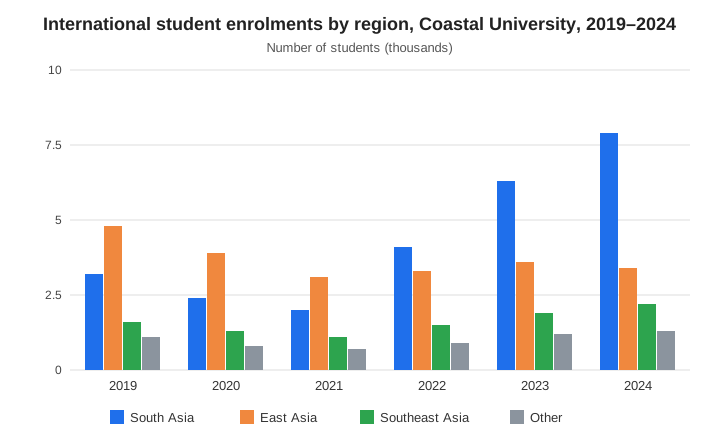
prep 25s · record 40s · ~1:05Look at the image. When recording starts, describe it in detail: the main trend, key numbers, and how the parts relate.
Prompt di-001 · target · education / statistics
Skills: speaking · Traits: content, pronunciation, oral fluency
Content key
- Main feature: South Asian enrolments rose sharply after 2021, from about 2,000 to about 7,900 by 2024, becoming the largest group.
- Detail: in 2019 East Asia was the largest group (about 4,800); it fell to about 3,100 in 2021 and stayed around 3,300–3,600 after.
- Detail: all four regions dipped between 2019 and 2021.
- Detail: Southeast Asia and Other stayed small, both under about 2,200 throughout, with slow growth after 2021.
- Relationship: South Asia overtook East Asia in 2022, and by 2024 it was more than double East Asia.
- Relationship: overall, growth after 2021 came mainly from South Asia.
5. Re-tell Lecture
audio ~75s · prep 10s · record 40s · ~2:05You will hear a short lecture once. Then re-tell it in your own words, covering the main points.
Prompt rl-002 · target · linguistics · plays as audio
Skills: listening + speaking · Traits: content, pronunciation, oral fluency
In today's session, I'd like to explain how languages borrow words from each other. First of all, borrowing happens through contact. When people trade, travel or migrate, they pick up words for things they didn't have names for. The word coffee, for example, passed through Arabic and Turkish before reaching European languages. Second, borrowed words rarely stay the same. They change to fit the sounds of the new language. Japanese speakers took the English word television and shortened it to terebi. Third, borrowing usually fills a gap. New technology and new ideas need new words, and it's often easier to adopt an existing one than to invent one. However, not everyone welcomes this. Some countries have official bodies that recommend local alternatives to foreign words. Even so, most linguists see heavy borrowing as a sign that a language is alive and adapting, not that it's in decline.
Content key
- Borrowing comes from contact between peoples (trade, travel, migration); example: 'coffee' passed through Arabic and Turkish.
- Borrowed words change to fit the new language's sounds; example: Japanese 'terebi' from 'television'.
- Borrowing fills gaps, mostly for new technology and ideas, because adopting a word is easier than inventing one.
- Some countries resist it with official bodies recommending local words, but most linguists see borrowing as a sign of a living, adapting language.
6. Answer Short Question
audio ~4s · prep 3s · record 10s · ~0:17You will hear a question. Answer it with a single word or a few words.
Prompt asq-003 · foundation · daily life · plays as audio
Skills: listening · Traits: contentListening only, not counted in speaking score
Where can members of the public borrow books for free?
Accepts: library / a library / the library / public library / a public library
Content key
- library (also accepted: public library)
7. Answer Short Question
audio ~3s · prep 3s · record 10s · ~0:16You will hear a question. Answer it with a single word or a few words.
Prompt asq-002 · foundation · nature · plays as audio
Skills: listening · Traits: contentListening only, not counted in speaking score
What do we call an animal that eats only plants?
Accepts: herbivore / a herbivore / an herbivore / herbivores
Content key
- herbivore
8. Respond to a Situation
audio ~18s · prep 10s · record 40s · ~1:08Read and listen to the situation. Then respond as you would in real life, speaking directly to the person involved.
Prompt rts-001 · target · university life · plays as audio
Skills: speaking · Traits: content, pronunciation, oral fluency
You reserved a library study room for your group's presentation practice this afternoon. When you arrive, another group is using it and they have a booking for the same time. Your presentation is tomorrow morning. Explain the problem to the library staff member at the front desk and ask for help.
Content key
Goal: Explain the double booking and ask the staff member to help find a solution.
Register: Polite, semi-formal: a service request to a staff member, not a complaint or a peer chat.
- States they had a reservation for this afternoon and another group is in the room with a booking for the same time.
- Mentions the urgency: the presentation is tomorrow morning.
- Makes a clear request: check the booking or find another room or time.
9. Summarize Group Discussion
audio ~170s · prep 10s · record 120s · ~5:00You will hear three people discussing a topic, once. Then summarize the discussion: each speaker's main view and how their views relate.
Prompt sgd-001 · target · education · plays as audio
Skills: listening + speaking · Traits: content, pronunciation, oral fluency
Three students discuss whether first-year university exams should be replaced with continuous assessment.
Priya: I think first-year final exams should go. Everything depends on one three-hour sitting, and for students who've just moved to a new country, that's a lot of pressure in their first semester.
Daniel: I understand Priya's point about pressure, but continuous assessment just spreads the stress over the whole term. You'd have something due every week. With an exam, at least you can plan around a single date.
Mei: I'm somewhere in between. Exams check whether you can recall things under time pressure, which matters in some subjects. But in subjects like design or writing, a series of assignments shows much more about what you can actually do.
Priya: That's true, Mei, and regular tasks mean you get feedback early. If you've misunderstood something in week three, you find out in week four, not after the final.
Daniel: Fair enough. But there's also cheating to think about. Take-home assignments are much easier to get someone else to do now, especially with AI tools. An exam room is at least supervised.
Mei: That's exactly why I'd combine them, Daniel. Keep a shorter exam, worth maybe forty percent, and make the rest in-class tasks. Students get early feedback, and there's still some protection against cheating.
Daniel: I could accept that, as long as the in-class tasks aren't every single week.
Priya: I'd agree with Mei's plan too. Even every two weeks would be much better than everything depending on one day.
Content key
- Priya: wants to replace first-year exams; one high-stakes exam puts too much pressure on new (especially international) students.
- Priya: continuous tasks give early feedback, so misunderstandings are caught sooner.
- Daniel: prefers exams; continuous assessment spreads stress across the term with constant deadlines.
- Daniel: take-home work is easier to cheat on, especially with AI; exams are supervised.
- Mei: middle position; exams suit some subjects (recall under pressure), assignments suit others (design, writing).
- Mei: proposes a mix, a shorter exam (about 40%) plus in-class tasks, combining feedback with cheating protection.
- Outcome: all three move toward Mei's mixed model; Daniel's condition is that tasks aren't weekly, and Priya suggests fortnightly.
Cross-references
- Daniel accepts Priya's pressure concern but argues continuous assessment only spreads it.
- Priya builds on Mei's point with the feedback argument.
- Mei answers Daniel's cheating concern with in-class tasks.
- Priya and Daniel both end up endorsing Mei's plan.